Search


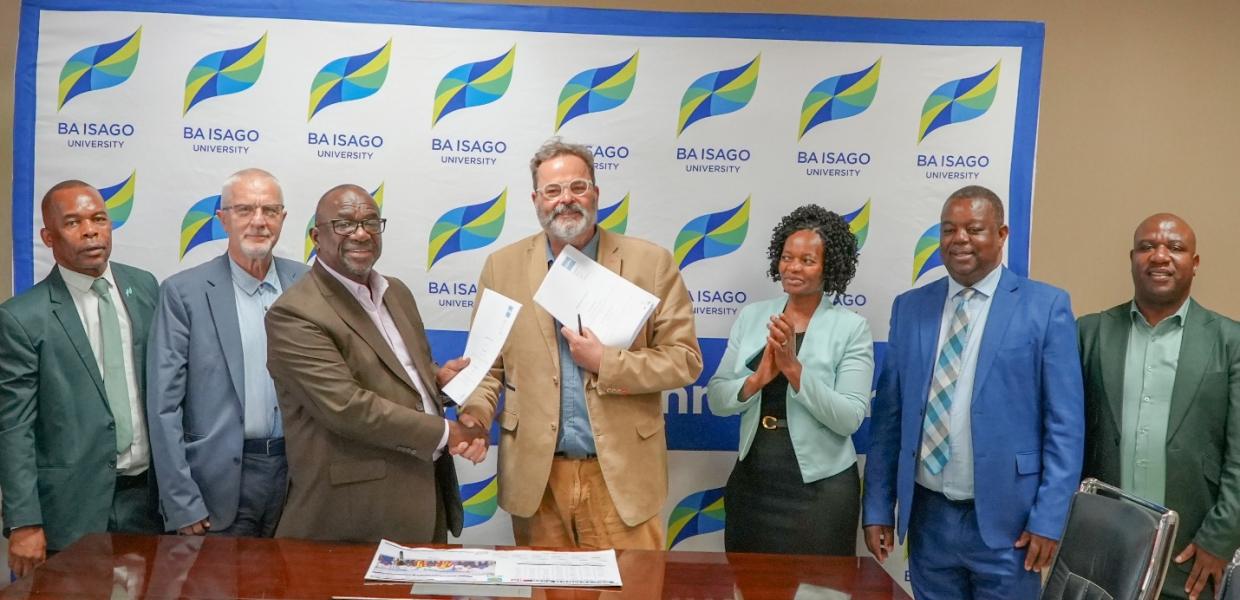
BA ISAGO University recently hosted a group of Master of Urban Design (MUD) students from the School of Architecture, University of the Witwatersrand (Wits), Johannesburg, for an intensive four-day Global Studio in Gaborone from 20–23 September 2026. The visit strengthened academic and professional cooperation in urban design between Botswana and South Africa. The Global Studio brought together Wits MUD students and academics, BA ISAGO Master of Urban Planning and Design (MUPD) Students, Staff and representatives from Botswana’s built-environment professions. The programme combined academic exchange, professional engagement, field investigations, urban analysis and Student presentations focused on Gaborone’s spatial structure, built environment and future development opportunities. The visit also coincided with the signing of a Memorandum of Agreement (MoA) between BA ISAGO and the Urban Design Institute of South Africa (UDISA), providing further opportunities for cooperation in urban design education, professional development, research and practice across Southern Africa.
The Wits delegation was led by Prof Ludwig Hansen, Convener of the Wits Master of Urban Design Programme, and included eight MUD students. Gaborone was selected as the case study for the Global Studio, allowing students to investigate an African capital city outside South Africa and engage directly with its planning history, urban morphology and contemporary development challenges. The programme began with an orientation tour through inner-city Gaborone, giving the visiting students an opportunity to experience the city’s diverse spatial environments. A skyline overview from Room52 at iTowers provided a broader perspective on Gaborone’s evolving urban form, particularly the relationship between the emerging Central Business District (CBD) and older areas of the city.
The Students also visited areas including Ledumang Mall and surrounding neighbourhoods. These contrasting environments encouraged comparative discussions with urban settings familiar to the Wits participants, including Johannesburg and Soweto. Discussions explored urban form, commercial development, public spaces, mobility, neighbourhood character and patterns of urban transformation.
The academic programme continued at BA ISAGO’s Faculty of the Built Environment, Arts and Science (FBEAS), where the visiting delegation engaged with members of the University’s Executive Management Team, the Curriculum Development and Quality Assurance (CDQA), Academic Staff and Students, as well as a representative of the Architects Registration Council (ARC) Botswana. The session highlighted the importance of connecting academic development, quality assurance and professional recognition in advancing urban design education in Botswana.
BA ISAGO introduced the delegation to its academic and research activities and postgraduate programmes, including the existing MUPD and its planned transition towards a more explicitly urban-design-focused MUD. Dr Hansen also presented the Wits MUD programme, creating an opportunity for both Institutions to compare and align approaches to postgraduate urban design education and explore possibilities for joint studios, student and staff exchanges, research and other collaborative initiatives.
A central objective of the Global Studio was to expose the Wits students to Gaborone as a living urban laboratory. The students undertook field investigations across the Gaborone Central Core Area, including the Government Precinct, commercial CBD, industrial areas, Main Mall and surrounding residential neighbourhoods. Their investigations examined urban structures and morphology, land-use patterns, movement and connectivity, public spaces, built form, landmarks and development pressures. The students also engaged with Moralo Design, where they were introduced to professional projects and contemporary built-environment practice in Botswana. The fieldwork extended beyond the city centre to the wider metropolitan and environmental setting, including areas around the University of Botswana, Kgale Hill and Gaborone Dam. Students subsequently used the GISPlan premises as a working environment to analyse and consolidate their findings, transforming observations, photographs, mapping and discussions into preliminary urban design findings and visual material.
The process provided valuable opportunities for comparing the perspectives of Wits students with those of BA ISAGO Students and Professionals who have direct knowledge of Gaborone and Botswana’s planning context. The exchange also demonstrated how students can interpret and analyse a city with which they are initially unfamiliar while developing strategies and design principles informed by local conditions.
The Global Studio concluded on the 23rd September 2026, with a presentation and discussion at the BA ISAGO Design Studio (TR13). Wits students presented their preliminary findings and urban design analysis to BA ISAGO MUPD/MUD and senior Landscape Architecture Students, Academics and invited professional partners.
The session was structured as a joint urban design critique and knowledge-exchange platform rather than simply a presentation by the visiting students. Botswana participants were encouraged to scrutinise the findings, contribute local knowledge, question interpretations and provide perspectives that could support further development of the studio project.
For BA ISAGO Students, the exercise provided an opportunity to observe how students from another established African urban design programme approached site investigation, spatial analysis, urban design thinking and visual communication. For the Wits students, engagement with Botswana students, academics and practitioners provided important local perspectives against which their preliminary interpretations could be tested. The exchange of information, planning data and GIS information further strengthened their understanding of Gaborone and supported their research and studio requirements. Such exchanges contribute to the internationalisation of postgraduate education by enabling students to move beyond familiar institutional and national contexts and develop comparative, multidisciplinary and culturally informed approaches to understanding cities.
The Global Studio was accompanied by another significant development: the signing of a Memorandum of Agreement between and the Urban Design Institute of South Africa (UDISA). The agreement provides an institutional platform for closer cooperation in urban design education, professional development and interaction between academia and practice. It is particularly timely as BA ISAGO continues to strengthen its postgraduate urban design education and progress with the transformation of its MUPD programme towards a Master of Urban Design.
Engagement with UDISA creates opportunities to connect Botswana’s emerging urban design education and professional community with a wider Southern African network. Areas of potential collaboration include professional standards, urban design competencies, education, research and continuing professional development. The Wits Global Studio and BA ISAGO–UDISA agreement demonstrate the value of linking education, professional practice and regional cooperation. The developing relationship between BA ISAGO, Wits MUD and UDISA creates opportunities for future joint urban design studios, student and staff exchanges, visiting lecturers, research projects, exhibitions, professional workshops, continuing professional development programmes and consultancy initiatives.
There is also potential for collaborative research addressing urban challenges relevant to Southern African cities, including rapid urbanisation, urban regeneration, public-space quality, mobility and connectivity, climate resilience, landscape systems, digital urban technologies and the planning and design of cities in arid and semi-arid environments. For Botswana, these partnerships are particularly significant as the country continues to develop its capacity in urban design education and professional practice.
The September 2026 Global Studio demonstrated that internationalisation can take place directly within the city through students undertaking fieldwork together, academics exchanging ideas, professionals sharing experience and different interpretations of the same urban environment being discussed and tested in the design studio.
The programme also demonstrated Gaborone’s value as an African urban design laboratory, offering important lessons on planned capital-city development, urban transformation and the challenges of creating more connected, resilient and people-centred urban environments.
The four days of joint activities therefore represented more than a student field trip. They marked another step towards building a stronger network of urban design education, research and professional collaboration between Botswana and South Africa.
With the BA ISAGO–UDISA agreement now in place and cooperation with the Wits Master of Urban Design programme developing further, the foundations have been laid for sustained collaboration that can benefit students, academics and professionals and ultimately the cities and communities they serve.